By early 1314, Robert the Bruce had spent years systematically reclaiming Scottish strongholds from English control. Only a few major fortresses remained in English hands, most notably . The castle's governor, Sir Philip Mowbray, had struck a deal with Bruce's brother, Edward: if an English relief force did not arrive by midsummer (June 24), the castle would be surrendered. Edward II could not ignore this challenge and assembled the largest army ever to invade Scotland to break the siege. The Armies and Strategy
Bannockburn 1314: Robert Bruce's Great Victory The Battle of Bannockburn, fought on , stands as the most significant military victory in the First War of Scottish Independence . Under the leadership of King Robert I (the Bruce) , a smaller, primarily infantry-based Scottish force decisively defeated a much larger English army commanded by King Edward II . This triumph not only secured Bruce’s tenuous claim to the throne but ultimately paved the way for the recognition of Scotland as an independent kingdom. Prelude to Conflict
Bruce chose the battlefield near the (stream) with extreme care, utilizing marshy ground and digging concealed anti-cavalry pits to funnel the English into a narrow, restricted area where their superior numbers would become a liability. The First Day: June 23, 1314
: Led by Robert the Bruce, numbering approximately 5,000 to 8,000 men , primarily disciplined pikemen organized into schiltrons (dense circles or blocks of spearmen).
The battle began with a legendary encounter. Spotting Robert the Bruce alone on a small horse, an English knight named charged him with a lance. Bruce remained calm, sidestepped the attack at the last second, and standing in his stirrups, split de Bohun's skull with a single blow from his battle-axe. This act of personal bravery electrified the Scottish ranks and severely dented English morale.
: Commanded by King Edward II, estimated at 13,000 to 25,000 men , including 2,000–3,000 heavily armored cavalry and thousands of longbowmen.
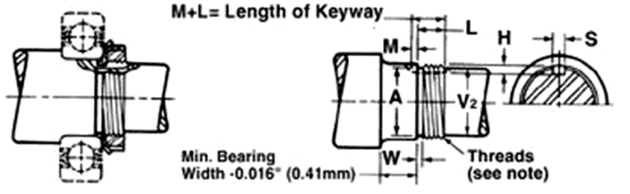
External Lock Nut Threads per ABMA 8.2
Bannockburn 1314: Robert Bruce's Great | Victory ...
By early 1314, Robert the Bruce had spent years systematically reclaiming Scottish strongholds from English control. Only a few major fortresses remained in English hands, most notably . The castle's governor, Sir Philip Mowbray, had struck a deal with Bruce's brother, Edward: if an English relief force did not arrive by midsummer (June 24), the castle would be surrendered. Edward II could not ignore this challenge and assembled the largest army ever to invade Scotland to break the siege. The Armies and Strategy
Bannockburn 1314: Robert Bruce's Great Victory The Battle of Bannockburn, fought on , stands as the most significant military victory in the First War of Scottish Independence . Under the leadership of King Robert I (the Bruce) , a smaller, primarily infantry-based Scottish force decisively defeated a much larger English army commanded by King Edward II . This triumph not only secured Bruce’s tenuous claim to the throne but ultimately paved the way for the recognition of Scotland as an independent kingdom. Prelude to Conflict Bannockburn 1314: Robert Bruce's great victory ...
Bruce chose the battlefield near the (stream) with extreme care, utilizing marshy ground and digging concealed anti-cavalry pits to funnel the English into a narrow, restricted area where their superior numbers would become a liability. The First Day: June 23, 1314 By early 1314, Robert the Bruce had spent
: Led by Robert the Bruce, numbering approximately 5,000 to 8,000 men , primarily disciplined pikemen organized into schiltrons (dense circles or blocks of spearmen). Edward II could not ignore this challenge and
The battle began with a legendary encounter. Spotting Robert the Bruce alone on a small horse, an English knight named charged him with a lance. Bruce remained calm, sidestepped the attack at the last second, and standing in his stirrups, split de Bohun's skull with a single blow from his battle-axe. This act of personal bravery electrified the Scottish ranks and severely dented English morale.
: Commanded by King Edward II, estimated at 13,000 to 25,000 men , including 2,000–3,000 heavily armored cavalry and thousands of longbowmen.
Disclaimer
This data is provided for general information only. The intention is to provide accurate information; regardless; errors may exist in the supplied information. If accuracy is critical, base your final decisions on the data provided in the root document; which is a copyrighted document. To purchase a copy visit an Authorized Reseller.
Comments
Original Posting: 3/2/2011
Last Revision: 3/23/2018
Error corrections in, or comments about, the above data can be sent to:
Gage Crib Worldwide, Inc.
6701 Old 28th St SE, Suite B
Grand Rapids, MI 49546-6937
Phone: 001-616-954-6581 • Fax: 001-616-954-6583 CONTACT FORMS & INFO